
The Power of “What If?”
What if we could build something of our own?
This is the question 15 Maasai women in Lemong’o asked themselves when they began imagining a beekeeping enterprise that could create income without demanding large tracts of land or placing further pressure on the environment.
Apiculture offered a compelling possibility: an enterprise rooted in the health of the landscape itself, where flowering plants, indigenous vegetation and healthy ecosystems could support both bees and livelihoods.
They did not begin with funding, but with a strong belief in themselves and in what they might build together.
An elder in the community believed in their vision and was kind enough to donate a piece of land for the apiary. The women then found someone to construct a shelter for the hives, while the beehives themselves were donated, bringing a once-imagined idea into something tangible that they could begin to build, manage and call their own.
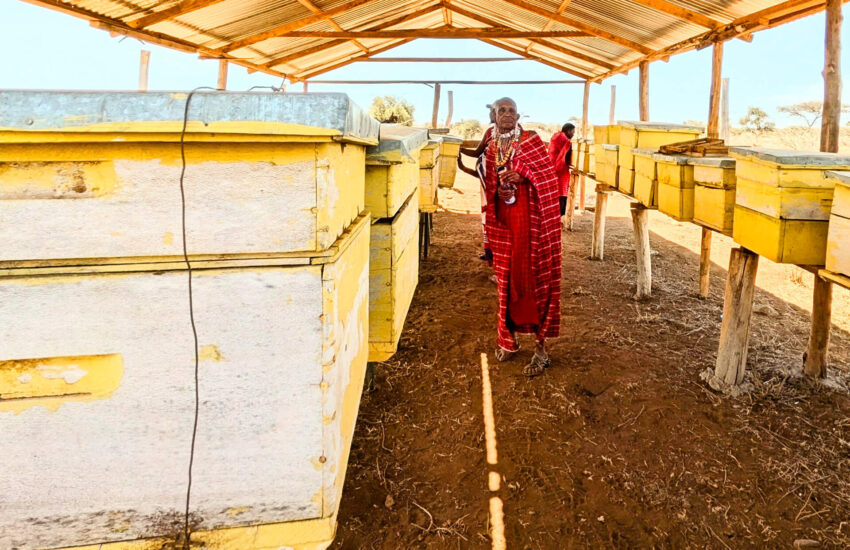
Today, 35 hives sit within the apiary managed by the women.
The journey there, however, has been anything but straightforward.
When the project began roughly five years ago, the hives were hung from trees. It seemed the natural place for them, until honey began to disappear.
Theft forced the women to reconsider.
For safekeeping, the hives were moved into the manyatta. That solved one problem and promptly created another. The bees began migrating from the hives into the living quarters, turning an income-generating idea into an uncomfortable neighbor for the families sharing the space.
So the women adapted again.
The hives were moved into a purpose-built structure outside the manyatta, where they could be protected without bringing the bees into people’s homes. Since that move, the problem of bees migrating into the living space has stopped. The group has also harvested approximately 20 kilograms of honey.
While the project has had its fair share of setbacks, the women did not abandon it.
They adjusted, and that willingness to learn, reconsider and try again became a quiet expression of resilience: not merely enduring difficulty, but finding another way forward when the first one did not work.
Their ambition now extends beyond simply keeping bees.
The women process their own honey using sieves and have acquired protective clothing for harvesting. They maintain the hives and continue to deepen their practical understanding of apiary management. Their customers have so far largely come through Conservation Kenya’s network, although developing a more structured route to market remains an important next step.
Conservation Kenya has been keen to strengthen what the women have already begun.
After the challenges facing the apiary were shared publicly, Nina Chauvel, founder of Manda Bees, offered to help.
All 15 women took part in a virtual beekeeping training session designed to deepen their practical knowledge of hive management, strengthen their confidence and equip them with skills they can apply as the apiary grows.
With stronger knowledge of how to care for their colonies and manage the apiary, the women are better equipped to create the conditions in which healthier colonies can thrive, produce honey and, ultimately, generate income for their families.
There is still work ahead. The apiary needs to develop into a stronger enterprise, the women need more reliable routes to market, and their knowledge will continue to deepen through training and experience as the infrastructure and surrounding site are improved.
Yet perhaps resilience is not measured by having reached the destination.
Perhaps it is found in the decision to keep going when the route changes.
These women began with an idea, encountered setbacks, adapted their approach, sought new knowledge and continued building. Their apiary stands as evidence that resilience is the confidence to respond to challanges, learn from it and continue creating something better.
For the women of Lemong’o, “What if?” became the beginning of what they were willing to build for themselves.
